

Blog
Shimmering Vineyards, Racing Time: How High-Value Orchards Crush the Labor-Sucking Trap of Frost Candles

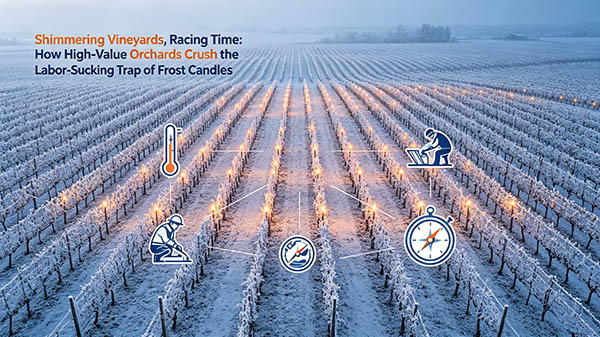
In the chilly spring midnights of Bordeaux, Burgundy, or Napa Valley, you might witness a breathtaking spectacle: tens of thousands of flickering fires illuminating the vine-covered hills like a galaxy on earth. This is no romantic ritual—it is a life-or-death battle waged by winegrowers and vineyard managers to defend vulnerable grape buds against lethal spring frosts.
As a critical weapon for microclimate mitigation, frost candles (also known as bougies de gel) remain indispensable for high-value crops. However, behind this viral visual marvel lies a brutal bottleneck that torments farm owners: extreme labor consumption. Learning how to skyrocket ignition efficiency during a narrow window is the ultimate game-changer for vineyard survival and ROI (Return on Investment).
1. Frost Candles: Microclimate Saviors vs. “Labor Monsters”
The Core Mechanism of Frost Protection
Typically made of paraffin or vegetable wax, frost candles do not just “bake” the vines. Instead, their targeted combustion releases intense heat that breaks the nighttime thermal inversion layer. By heating the freezing air near the ground, it forces it to rise while drawing down the warmer air trapped above. This creates a continuous radiant heat blanket over the canopy, stopping bud cells from freezing at critical sub-zero temperatures.
The Fatal Flaws of Traditional Methods
While highly effective against radiation frosts between -3°C and -4°C, traditional frost candles come with severe pain points:
- Black Smoke & ESG Compliance Pressure: Legacy paraffin candles emit thick black soot, clashing directly with tightening EU organic certification and environmental regulations.
- Brutal Labor Costs (The Ultimate Pain Point): When a cold wave hits, ignition relies 100% on manual labor. At 2 AM in freezing wild fields, workers must fight the wind to uncap, light, and move from candle to candle. With global agricultural labor shortages and skyrocketing night-shift overtime pay, a few frost nights can effortlessly drain a chateau’s seasonal cash flow.
Industry Innovation: Addressing this exact vulnerability, TABO Frost Candles introduces customized burning times. Vineyard owners can adapt specs (6-hour, 8-hour, or 12-hour durations) based on local historical weather data. This custom hedge minimizes material waste and perfectly matches local frost cycles.
3. Hacking the System: The “3-Hour Frost Night SOP” for Lean Teams
When a frost strikes, the critical rescue window—the time it takes for the ground temperature to drop from 0°C to the critical bud damage threshold (e.g., -2.5°C)—is brutally short, usually only 30 to 45 minutes.
Using traditional methods (averaging 10 seconds per candle), a single worker would take over 66 minutes to light 400 candles. The vines at the end of the line would freeze long before help arrives. To solve this with a lean crew, vineyards must execute this extreme efficiency SOP:
Step 1: Daytime Pre-Staging—The “Loose-Lid” Method (Saves 30% Time)
Traditional metal candle lids are tightly sealed to prevent moisture. Prying them open at midnight with thick winter gloves completely destroys operational speed.
- The Hack: On the afternoon before the frost (right after the meteorological alert is triggered), send a skeleton crew to pry open all metal lids and rest them loosely on top of the cans. This blocks evening dew while allowing midnight crews to easily flick or kick the lids off instantly.
Step 2: Hardware Upgrade—Backpack Propane “Thermal Lances” (< 2 Seconds per Candle)
Ban standard butane lighters. They constantly extinguish in freezing winds, and making workers bend over 400 times causes rapid physical fatigue.
- The Hack: Equip your core team with long-handled agricultural thermal lances connected to backpack propane tanks. These lances produce a powerful, windproof flame jet. Workers walk at a normal pace without bending over, sweeping the flame across the wax to ignite it instantly. This slashes individual ignition time from 10 seconds to under 2 seconds.
Step 3: Array Optimization—The 1/2 Intersect Grid Strategy
Never try to light all 400 candles in the first minute. It causes chaotic labor bottlenecks.
- The Hack: When the temperature first dips below 0°C, ignite only the outer windward perimeter and every other candle inside the field (a chessboard grid). This establishes an initial thermal convection web. If the weather station shows temperatures plunging past -3.5°C, loop back to ignite the remaining 50%, smoothly distributing labor stress across two manageable phases.
4. Summary: The Irreplaceability of Candles & Modern Alternatives
In an era of automated farming, why do the world’s elite vineyards stick with frost candles?
Why Frost Candles Cannot Be Abandoned
- Extreme Terrain Adaptability: On steep, terraced, or irregular hillsides in Burgundy or steep valley slopes, heavy machinery like frost fans cannot be installed or operated. Candles provide zero-blind-spot coverage.
- Zero Asset Depreciation: Compared to wind machines that cost tens of thousands of dollars, candles are a “pay-as-you-go” operational expense, requiring zero off-season maintenance or mechanical troubleshooting risks.
Modern Alternatives & The Ultimate Hybrid Strategy
To reduce labor reliance, automated vineyards are testing alternative tech:
- Wind Machines & Helicopter Downwash: These mix the upper warm inversion layers with cold ground air. However, they rely 100% on a strong inversion layer. If there is no warm air above, the fans fail completely.
- Automated Sprinkler Systems: These spray water continuously, locking the bud temperature at 0°C via the latent heat of fusion released as water freezes. It is automated and highly effective, but its water consumption is colossal. In regions with severe water rights restrictions like California, this is often unviable.
The Golden Combination: The highest ROI strategy in modern viticulture is a hybrid defense system (Wind Fans + Frost Candles). Run automated fans for mild frosts. When an extreme arctic blast breaks through, deploy a lean crew armed with thermal lances to rapidly spark frost candles. This approach saves labor, time, and budget while locking down an unbreakable heat barrier for high-value crops.
Want to print this out for your vineyard workshop? Click here to download the high-resolution, print-ready PDF Checklist.