

Blog
The Reality and Future of Anti-Frost Candles in European Orchards

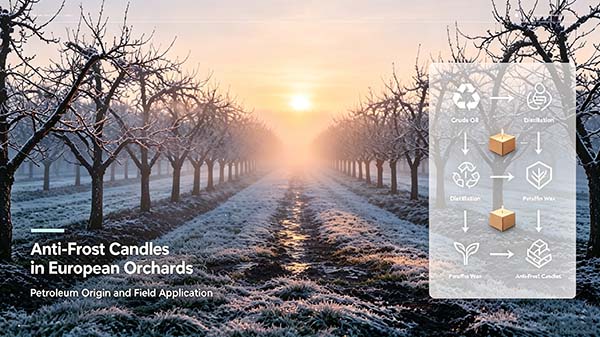
Every year from March to May, early spring brings the sudden dread of late spring frosts—the ultimate catastrophic nightmare for high-value European crops, particularly in the premier vineyards of Bordeaux, Burgundy, Tuscany, and Rioja. Facing the threat of an entire year’s harvest being wiped out overnight, growers have long relied on anti-frost candles (also known as vineyard smudge pots or bougies antigel) as their most direct, immediate, and time-tested lifeline.
However, caught between economic survival, rising labor inflation, and increasingly stringent European environmental regulations, this traditional agricultural sector is now on the brink of a profound transformation. Growers are actively searching for how to protect vineyards from late spring frost without bankrupting their operations or violating environmental laws.
1. The Cost War: Why the Market is Dominated by Paraffin-Based Candles
When browsing options for eco-friendly anti-frost candles for vineyards, buyers notice that over 80% of traditional products still utilize petroleum-based paraffin wax as their core raw material. This market dominance is driven by a calculated balance between rock-bottom material costs and thermal physics:
[Petroleum Refining Byproduct: Paraffin] ──> High Energy Density ──> 8-10 Hours Stable Burn
                                         ──> Low Melting Point  ──> Easy Ignition at -5°C
- Overwhelming Cost Advantages: As a byproduct of petroleum refining, paraffin is available globally in massive quantities at highly competitive wholesale prices. For commercial orchards that must deploy hundreds of units per acre, the initial raw material cost directly dictates the financial feasibility of frost defense.
- Superior Thermal Physics & Energy Density: Paraffin boasts an excellent calorific value. A standard 6-liter bucket of paraffin-based candle burns with remarkable stability, consistently releasing heat for 8 to 10 hours. This perfectly covers the critical “danger zone” from midnight to dawn when temperatures plunge to their lowest.
- Excellent Outdoor Weather Resistance: The agricultural environment is unforgiving. Paraffin does not absorb moisture, nor does it degrade when exposed to morning dew or frost. It remains highly stable during open-air pallet storage and can be ignited reliably even in sub-zero humidity.
2. A Harsh Reality: Three Operational Pain Points of Frost Candle Utilization in Europe
While these candles successfully raise the microclimate temperature of a vineyard canopy by 2°C to 3°C, European growers face heavy operational and financial burdens when deploying them at scale:
- Exorbitant Overall Expenses & Low ROI: To combat a severe freeze (down to -4°C or -5°C), a crop typically requires a dense deployment of 300 to 400 candles per hectare. A single three-night cold snap can burn through thousands of euros in hard product costs alone. For average orchards or low-margin fruit growers, this cash burn rate is simply unsustainable.
- Heavy Reliance on Manual Labor: Unlike automated systems, candles require intense manual labor. Teams must manually position the heavy buckets across fields ahead of time, light them one by one with torches in the freezing hours of the early morning, and subsequently extinguish them after sunrise. Against the backdrop of Europe’s strict labor laws, skyrocketing nighttime wage standards, and acute agricultural labor shortages, labor costs sometimes eclipse the cost of the wax itself.How High-Value Orchards Crush the Labor-Sucking Trap of Frost Candles
- An Exclusive Luxury for Elite Estates: Due to these steep financial and labor barriers, traditional anti-frost candles have shifted from a standard agricultural tool into a luxury asset. Currently, they are economically viable only for highly profitable, prestigious wine estates (such as Grand Crus) where the high retail premium on each bottle easily offsets the frost defense bill. Middle-market farmers are left vulnerable, desperately needing a cost-effective frost protection for fruit trees and vines.
3. The Green Crackdown vs. Crucial Advantages: Challenges and Strengths Ahead
With the roll-out of the European Green Deal and regional net-zero mandates, traditional paraffin candles find themselves at a historic crossroads, balancing regulatory pressure against irreplaceable field performance.
| Frost Protection Solution | Seasonal Cost per Hectare (EUR) | Core Advantages | Core Disadvantages | Applicable Frost Type | Market Penetration in European Farms |
|---|---|---|---|---|---|
| Wind Machines (Anti-frost Fans) | 1,950 upfront investment + 110 annual maintenance | Automated temperature start; consistent air mixing; raises canopy temp by 2–4°C; long operational lifespan (15+ years). | Unsuitable for sloped/alpine terrain; entirely ineffective under wind speeds ≥ 2.5 m/s; high overhaul costs. | Weak radiation frost, static night frost. | Highly popular in flat, large-scale orchards across the Netherlands and Belgium. |
| Overhead Sprinkler Frost Systems | 780 infrastructure + 270 seasonal water/utility costs | Unmatched protection against severe advective frost; latent heat released raises bud tolerance to frosts as low as -5°C. | High water consumption; restricted in water-scarce Mediterranean regions; risk of branch breakage from ice load. | Severe advective frost, continuous sub-zero cooling. | Mainstream solution in the Loire Valley (France) and irrigated orchards in Spain. |
| Fabric Cover & Mulch Insulation | 330 seasonal labor + material costs | Flame-free, eco-friendly, zero crop-burn risk, low technical threshold for smallholders. | Labor-intensive installation/removal; blocks sunlight; induces fungal diseases in humid tea gardens. | Super-mild, short-term radiation frost. | Small family farms in Portugal and backyard orchards in Eastern Europe. |
| Premium Full Plant-Based Frost Candle | 820 per frost event, 1,450 full seasonal cost | Low-smoke pure plant wax; fully compliant with EU Eco-label standards; stable combustion; zero chemical burn risk to buds. | High raw material costs (premium pricing for soy/coconut wax); lower combustion calorific value; financially unviable for large farms. | Moderate radiation frost, valley cold air accumulation. | High-end organic vineyards and premium tea estates across the EU. |
| Economical Blended-Material Frost Candle | 390 per frost event, 710 full seasonal cost (51% budget cut vs. full plant wax) | 50%+ cost savings; customizable burn durations (6h/8h/12h); full terrain adaptability; reliable bulk raw material supply. | Heat dissipates rapidly under strong winds; requires simple windbreak arrangements for maximum efficiency. | Moderate radiation frost, abrupt nocturnal temperature drops, hillside and valley frost. | Rapidly growing mainstream solution for mid-sized commercial orchards in Italy, Germany, and Greece. |
| Mobile Gas Orchard Heaters | 580 per frost event (fuel + rental costs) | Rapid regional heating; well-suited for contiguous flat farmland. | Elevated fire hazards near forested tea belts; high gas consumption; subject to strict EU site safety audits. | Moderate advective frost. | Limited deployment in non-forest fringe orchards in Central Europe. |
| Frost-Resistant Biostimulant Sprays | 290 per spraying cycle | Easy application; serves as an auxiliary cold-resistance enhancer; zero on-site setup required. | Only improves cold tolerance by 1–1.5°C; entirely ineffective below -2°C; poses a risk of flower burn during full bloom. | Pre-frost preventative maintenance only; ineffective as emergency protection. | Auxiliary supplementary solution utilized across all European cultivation hubs. |
⚠️ The Regulatory Challenges:
- Strict Limits on Black Smoke & Soot: Traditional paraffin emits significant amounts of black smoke, soot, and particulate matter (PM2.5) during combustion. In eco-sensitive regions like Champagne or Tuscany, local environmental authorities are tightening smoke emission regulations and introducing heavy fines for high-pollution open burning.
- Carbon Footprint Scrutiny: The carbon footprints of fossil-fuel derivatives are facing unprecedented regulatory evaluation. Wine brands attempting to market themselves as “Organic,” “Biodynamic,” or “Carbon-Neutral” cannot justify burning tons of petroleum products in their fields.
💡 The Irreplaceable Advantages:
Despite environmental pushback, candles possess distinct physical strengths that wind machines or sprinkler systems cannot match:
- Zero Infrastructure Requirements: Wind towers require building permits, concrete foundations, and heavy machinery access. Sprinkler systems require massive water reservoirs and complex plumbing. Candles require absolutely zero infrastructure.
- Immediate Microclimate Intervention: Air inversion layers are not always present for wind machines to exploit, and water freezing techniques can waterlog soils. Candles work strictly on thermal radiation, making them reliable regardless of soil or wind conditions.
4. The Field Reference Guide: Acreage Layout & Crop-Specific Density Configurations
When calculating your seasonal inventory, understanding the exact anti-frost candles per hectare calculation is critical to optimizing both frost-defense efficiency and your bottom line. Frost behavior changes based on terrain, wind flow, and the specific growth stage of the crop.
Below is a practical field reference blueprint for deploying TABO residual-based candles across different high-value European crops.
[Perimeter / Windward Border] ──> Dense Packing (Buffer Zone to block cold air drifts)
[Internal Rows / Vineyard Grid] ──> Staggered Checkerboard Layout (Radiant heat overlap)
① Vineyards (Grapes for Wine Production)
- Critical Temperature Threshold: -2°C to -3°C during budburst (early spring).
- Recommended Density: 300 to 400 candles per hectare (approx. 120 to 160 per acre).
- How to Place Frost Candles in Vineyards: Place a dense line of candles every 2 to 3 meters along the windward border (usually north or east). Inside the rows, space the candles in a staggered checkerboard pattern every 5 to 7 meters. This ensures the radiant heat plumes overlap perfectly beneath the vine canopy without scorching the low-hanging buds.
② Top-Fruit Orchards (Apples, Pears, and Quinces)
- Critical Temperature Threshold: -1.5°C to -2.5°C during full bloom. Apple blossoms are notoriously sensitive, and frost at this stage causes total flower drop.
- Recommended Density: 250 to 350 candles per hectare.
- Deployment Strategy: Since tree canopies are much higher off the ground than grapevines, candles should be placed directly in the center of the inter-row alleys. Avoid placing buckets directly under the branches to prevent heat stress on lower limbs. The rising thermal currents will naturally draw cooler air upward and warm the entire tree volume.
③ Stone-Fruit & Soft-Fruit Orchards (Cherries, Apricots, Plums, and Kiwifruit)
- Critical Temperature Threshold: -1°C to -2°C. Stone fruits bloom incredibly early in spring, making them highly vulnerable to sudden late-season freezes.
- Recommended Density: 400 to 500 candles per hectare (High-density emergency configuration).
- Deployment Strategy: For delicate crops, a multi-stage lighting strategy is highly recommended. Deploy 450 candles but light only 50% (alternating buckets) when the temperature hits 0°C. Light the remaining 50% only if the temperature continues to drop past -2°C.
5. The Disrupter: How TABO’s Residual-Based Frost Candles Close the Circular Economy Loop
How can a manufacturer eliminate the high carbon footprint and toxic soot of paraffin while driving wholesale costs below traditional market rates? To solve this industry deadlock, TABO has engineered an innovative paraffin wax alternative for spring frost, crafted entirely from upcycled industrial and organic residues.
[Industrial/Organic Waste Residues] ──(TABO Refining Tech)──> [Eco-Friendly Wax Base] ──> Near-Zero Soot & Lower Wholesale Cost
♻️ Upcycling for True “Zero-Waste” Circular Production
Instead of relying on crude oil extraction, TABO sources, reclaims, and refines secondary industrial residues—including non-food grade vegetable oil processing waste and commercial lipid byproducts. Material that would otherwise incur hefty disposal fees for industrial factories is granted a “second life” as high-thermal-output fuel within TABO’s supply chain. This approach exemplifies an industrial-grade circular economy that appeals directly to modern, eco-conscious buyers.
💰 Breaking the “Eco-Premium” Curse to Slash Procurement Costs
In most agricultural sectors, upgrading to a sustainable alternative means paying an “eco-premium” (as seen with expensive virgin soy or beeswax). TABO completely circumvents this paradigm. Because its core ingredients are derived from reclaimed residues, the product evades heavy European fossil-fuel taxes while significantly lowering manufacturing raw material costs. This enables TABO to offer a sustainable vineyard smudge pots wholesale solution that fits the budgets of small-to-medium orchards and standard commercial vineyards.
🌿 Seamless Alignment with European Environmental Audits
By completely abandoning traditional petroleum-based chemistry, TABO’s residual-material candles drastically reduce black smoke emissions . This design fulfills the grower’s rigorous operational demand for high heat output and low soot, It delivers a cost-effective, dependable “ecological shield” that farmers can trust and regulatory boards approve.
Conclusion
The future of European viticulture and fruit farming belongs exclusively to solutions that marry low-carbon footprints with practical economic viability. TABO’s residual-material anti-frost candles break the monopoly that elite estates held over premium frost protection. By introducing a smart, scalable, and sustainable alternative, TABO quietly safeguards the bountiful harvests and premium yields of Europe’s fields as winter fades into the promise of spring.
🛡️ Secure Your Next Harvest: Partner with TABO for High-Volume Wholesale
Are you a vineyard owner, orchard manager, or agricultural distributor preparing for the next volatile spring season? Don’t let unpredictable late-season frosts destroy your hard work and annual revenue.
By upgrading to TABO’s residual-based eco-friendly anti-frost candles, you get a premium-tier thermal shield that satisfies Europe’s strictest environmental audits—without the premium price tag.
Why B2B Buyers Choose TABO:
- Massive Cost Savings: Enjoy highly competitive wholesale pricing compared to virgin plant wax or traditional taxed paraffin options.
- Certified Green Compliance: Near-zero net carbon emissions and minimal smoke help you easily clear local European agricultural audits.
- Stable Commercial Supply: As an established manufacturer, we ensure seamless container-load logistics directly to European ports ahead of the critical frost window.
- Flexible OEM/ODM Options: Custom bucket sizes, private labeling, and specific pallet packing tailored to your farm’s machinery requirements.
📧 Request Your Free Field Test Report & Bulk Quote Today!
We welcome agricultural cooperatives, large-scale orchards, and international distributors to test the TABO difference.
- Email Us:
michael@tbcandle.com - WhatsApp / WeChat:
+86-15932211838 - Submit an Inquiry: Click the “Inquire Now” button below to provide your crop type and acreage, and our technical agronomy team will generate a customized deployment blueprint and bulk pricing list within 24 hours.