

Blog
The principle and application of 8-hour burning Anti-Frost candles specifically designed for vineyards.

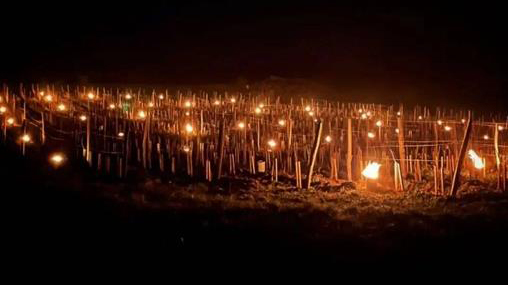
Late spring frost is a major disaster for grape cultivation, occurring most frequently between midnight and 6:00 AM. Low temperatures can damage tender buds, new shoots, and flower buds, directly causing reduced yield and lower quality; in severe cases, it can lead to total crop failure.
How does frost damage occur?
At night, under clear, windless skies, the ground cools rapidly, causing cold air near the ground to sink and form radiation frost. Grape buds and shoots are at the critical temperature for damage (0~-2℃); below this temperature, cells freeze and die.
Even a slight frost can stop the development of seedlings and buds, while severe low temperatures can cause seedlings to wither directly.
Frosts in European vineyards are primarily late spring radiation frosts. Climate warming is causing earlier bud break, making frosts more deadly, often occurring in multiple consecutive nights, with low temperatures leading to significant losses.
Therefore, orchard frost protection measures are an important measure that affects yield.
The following is a comparison of commonly used antifreeze solutions
| suggestion | shortcoming | advantage |
| irrigation | High water consumption and limited effectiveness in extreme low-temperature conditions | Easy to implement |
| Traditional firewood and straw smoke heating | Weak temperature rise, high pollution, and difficult to standardize,Burned seedlings | Low cost |
| Anti-frost fan | High cost, not suitable for large-scale planting | Safe, efficient, and environmentally friendly |
| Anti-frost candles | The cost is slightly higher, so advance ordering is required. | Highly efficient, environmentally friendly, and controllable |
The core principle of Anti-frost candles
The core principle is simple: the continuous burning of the candle releases heat energy, which directly raises the air temperature near the ground in the grapevine canopy, offsetting the heat loss from the ground surface and maintaining the local temperature above freezing, thus preventing frostbite. Therefore, the duration of the candle’s continuous burning determines the effect on raising the local temperature.
In addition, the thin smoke produced by the burning candle forms a heat-insulating aerosol layer, reducing heat loss from the ground and plants at night, thus achieving both warming and heat-locking effects.

Due to differences in the purity of raw materials used by antifreeze candle manufacturers, the burning time, heat output, and emissions of the candles vary, thus affecting the final result. The following are some reference experiences accumulated by Tabo anti-frost candle manufacturers over a long period of use:
How to use orchard frost candles
One candle can protect a 20-25m² (5x5m) area from frost, which is roughly enough for a medium-sized fruit tree (with a canopy height of up to 4m). 400 candles per hectare.

Red: 250 to 300 candles per hectare for frosts between -3°C and -4°C;
Blue: In addition, place 150 to 200 candles per hectare to be lit in a second phase for frosts between -4°C and -6°C if needed.

Recommendations on purchasing anti-frost candles
Bulk purchasing is preferable to individual purchases; prioritize agricultural-grade antifreeze candles and reject low-priced, substandard products; prepare inventory in advance based on the size of the orchard, completing procurement 1-2 weeks before the peak frost season.
- Weight: Preferably 900-1000g/unit, providing stable power for over 8-hour burning Anti-Frost candles; smaller sizes result in insufficient power, while larger sizes increase costs.
- Container: Thickened rust-proof iron drum packaging, with a built-in anti-tipping base, ventilation holes, and is heat-resistant and not easily deformed or damaged.
- Lamp: Dual/multi-wick design ensures even heating and stable firepower, preventing mid-flameout issues.
Overview of Anti-Frost candles usage
A qualified Anti-Frost candles burns stably for 8 hours and can raise the temperature by 2-4°C in windless conditions, making it the most cost-effective emergency antifreeze solution for small and medium-sized vineyards.
The quantity of candles to be purchased needs to be estimated in advance based on the vineyard’s planting area. This includes controlling the selection of specifications, adjusting the placement density appropriately, determining the timing of lighting, and ensuring fire prevention measures are in place.
Of course, if you have any questions about antifreeze candles or their use, please feel free to contact us. Tabo will provide you with solutions.
Partner with a 10-Year Anti-Frost CandleExpert
Direct factory pricing, reliable global shipping, and certified quality forvineyards & orchards worldwide.
Request a Free Quote & Catalog
We have over ten years of experience in producing antifreeze candles and offer custom candle services. We typically have three types of candles, with the following specifications:
Product Parameter Overview Table
| Specifications | Paraffin Wax Standard | Recyclable Premium | Vegetable Wax Organic |
| Main Material | High-Purified Paraffin Wax | Eco-Friendly Recyclable Blend | 100% Soy & Vegetable Wax |
| Burn Time Option | 8 Hours / 12 Hours (Customizable) | 8 Hours / 12 Hours (Customizable) | 8 Hours / 12 Hours (Customizable) |
| Smoke Property | Standard Industrial Smoke | Standard Industrial Smoke | Standard Industrial Smoke |
| Best For | Massive Commercial Orchards | Cost-Conscious Long-Term Vineyards | Premium High-Value Organic Vineyards |
Reference table for the quantity of anti-frost candles used in orchards
| Temperature below 0°C | – 2° | – 3° | – 4° | – 5°~ -6° | – 6°~ – 7° |
| Number of candle necessary for the hectar | 200 | 250-300 | 300-350 | 350-400 | 400-500 |
(Figures given for a spring frost by no wind)
Always positive efficiency in the normal conditions of use. It’s better to position 350 to 400 candles in the hectar and to light(to switch on) at first 200 to 250 candles in the hectar and the rest according to the evolution of the temperature.