

Blog
Anti-Frost Candles vs Frost Fans: Which Is Better for Small Vineyards?

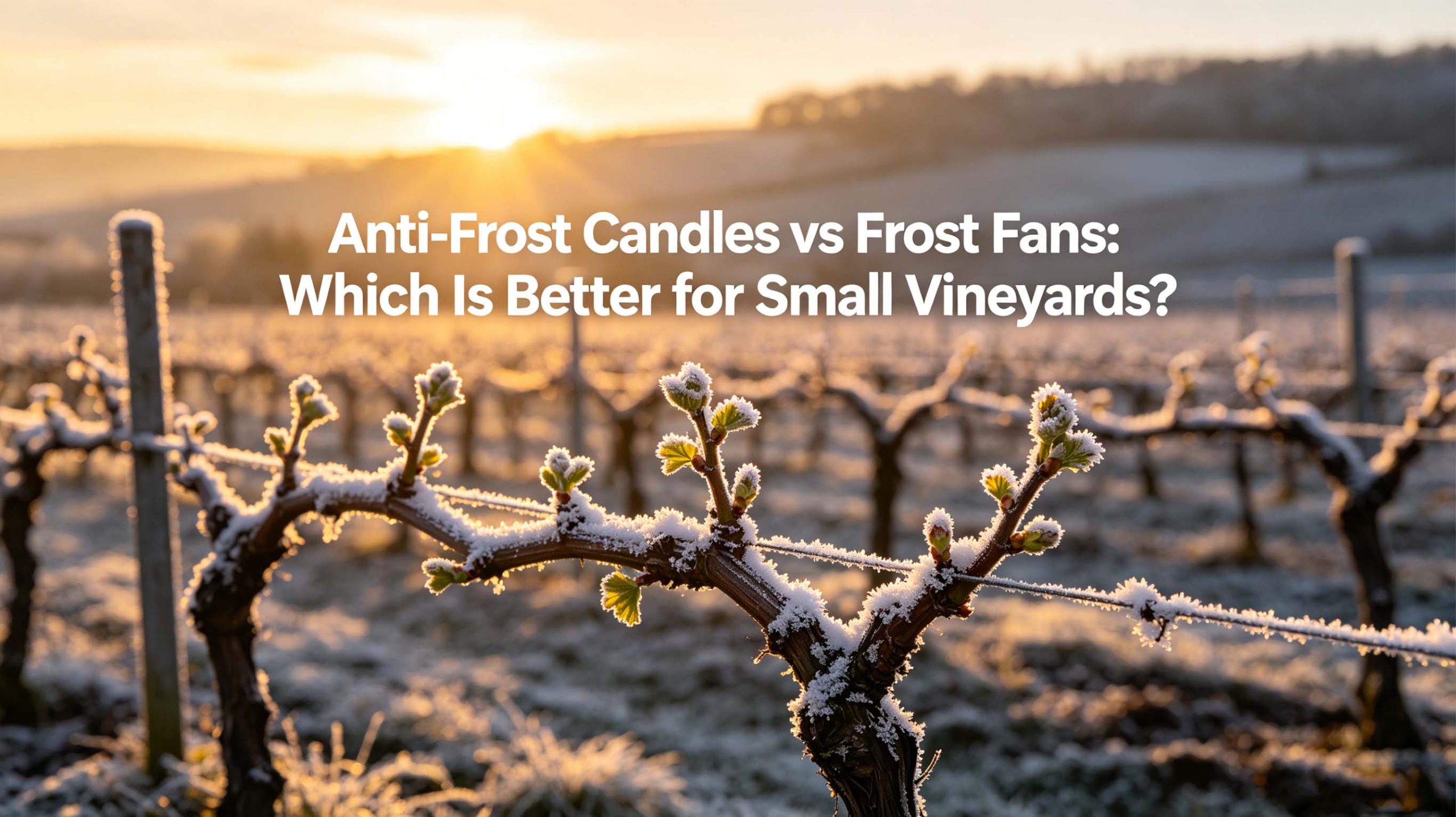
In recent years, late spring frosts have been frequent in Europe (most common from March to May). The low temperatures damage grape buds and flower buds, resulting in reduced yields or even total crop failure, posing a major threat to small vineyards.
How to adopt effective frost prevention measures? Currently, the three most commonly used frost prevention measures are: irrigation, frost-proof fans, and frost-proof candles.
Anti-Frost Candles vs Frost Fans: Which Is Better for Small Vineyards?
This article will provide an in-depth comparison of two solutions across five dimensions: procurement cost, ease of use, applicable terrain, frost protection effect, and maintenance cost, helping small vineyards choose the most cost-effective frost protection method.
Why Spring Frost Is a Big Threat to European Small Vineyards
In Europe, nighttime temperatures can plummet, causing radiation frost. When temperatures drop below 0°C, it can freeze and damage vineyard seedlings or saplings, resulting in significant losses for fruit growers overnight.
Currently, the mainstream frost prevention measures include the following:
Irrigation, antifreeze fan, anti-frost candles.
Irrigation or using fire is relatively easy to implement, but the irrigation effect is very limited, and there is a risk of freezing due to low temperatures. Relying on fire to raise the temperature is not easy to operate and may also freeze grape seedlings or vines, so neither is a reliable solution.
Using antifreeze fans and anti-frost candles is the best solution for most vineyards to prevent frost damage.
do frost fans work for small orchards
Working logic: Utilize the descending warm air from high altitudes to break up the cold air deposition layer and balance the overall temperature of the park.
Antifreeze fans rely on mechanical temperature control, making them easy to operate and quick to start when frost occurs, offering great convenience. However, they are limited by terrain and are only suitable for large areas of flat vineyards and orchards.
Anti-Frost Candles Working Principle
The core principle is simple: the continuous burning of the candle releases heat energy, which directly raises the air temperature near the ground in the grapevine canopy, offsetting the heat loss from the ground surface and maintaining the local temperature above freezing, thus preventing frostbite. Therefore, the duration of the candle’s continuous burning determines the effect on raising the local temperature.
In addition, the thin smoke produced by the burning candle forms a heat-insulating aerosol layer, reducing heat loss from the ground and plants at night, thus achieving both warming and heat-locking effects.

Initial Purchase Cost
Frost Fans: High unit price, several thousand euros per unit, plus the cost of wiring and installation; multiple units are needed for multiple plots, placing a huge burden on small farms.
Anti-Frost Candles: Zero upfront fee, bulk purchase as needed, partial stocking available, minimum cost to complete anti-freeze deployment.
Terrain & Size Adaptability
- Frost Fans: Only compatible with large areas of flat land; largely ineffective on slopes and small, fragmented vineyards, limiting installation options.
- Anti-Frost Candles: No terrain restrictions; usable on flat land, slopes, terraces, and scattered orchards; perfectly suited for small European mountain vineyards.
Frost Resistance Performance
Frost Fans: Suitable for light frost (-1℃~0℃); frost protection significantly reduces in extreme low temperatures and windless weather.
Anti-Frost Candles: A single set can withstand temperatures as low as -5℃, with stable performance in low-temperature environments, suitable for sudden extreme frosts.
Our Verdict: Which One Should You Choose?
Choose Frost Fans if:
Large-scale flatland vineyards with a planting area of 100 mu or more; sufficient budget to cover equipment procurement, electricity costs, and operation and maintenance costs; long-term fixed vineyard location, eliminating the need for frequent adjustments to frost protection points.
Choose Anti-Frost Candles if:
Small vineyards and family orchards with a planting area of less than 50 mu (90% target audience)
The land is on slopes or terraces, making it impossible to install anti-freeze fans.
They want a low-cost, low-risk, and emergency-response anti-freeze solution.
They need rapid deployment of protective measures in the event of sudden frost.
Bonus: Best Way to Use Anti-Frost Candles for Vineyards
How to use orchard frost candles
One candle can protect a 20-25m² (5x5m) area from frost, which is roughly enough for a medium-sized fruit tree (with a canopy height of up to 4m). 400 candles per hectare.

Red: 250 to 300 candles per hectare for frosts between -3°C and -4°C;
Blue: In addition, place 150 to 200 candles per hectare to be lit in a second phase for frosts between -4°C and -6°C if needed.

Product Parameter Overview Table
| Specifications | Paraffin Wax Standard | Recyclable Premium | Vegetable Wax Organic |
| Main Material | High-Purified Paraffin Wax | Eco-Friendly Recyclable Blend | 100% Soy & Vegetable Wax |
| Burn Time Option | 8 Hours / 12 Hours (Customizable) | 8 Hours / 12 Hours (Customizable) | 8 Hours / 12 Hours (Customizable) |
| Smoke Property | Standard Industrial Smoke | Standard Industrial Smoke | Standard Industrial Smoke |
| Best For | Massive Commercial Orchards | Cost-Conscious Long-Term Vineyards | Premium High-Value Organic Vineyards |
Reference table for the quantity of anti-frost candles used in orchards
| Temperature below 0°C | – 2° | – 3° | – 4° | – 5°~ -6° | – 6°~ – 7° |
| Number of candle necessary for the hectar | 200 | 250-300 | 300-350 | 350-400 | 400-500 |
(Figures given for a spring frost by no wind)
Always positive efficiency in the normal conditions of use. It’s better to position 350 to 400 candles in the hectar and to light(to switch on) at first 200 to 250 candles in the hectar and the rest according to the evolution of the temperature.